Token Incentives Matter: What Steemit (STEEM) Teaches Us About Tokenomics
Examining the crucial lessons from Steemit and the STEEM token about designing effective token incentive structures in Web3 ecosystems.
Aligning incentives is the core element of effective tokenomics. In decentralized ecosystems, participants’ actions are driven by the rewards and penalties embedded in the system’s design. When incentives are properly aligned, they encourage long-term engagement, fair participation, and overall ecosystem growth. Poorly structured incentives, on the other hand, can lead to manipulation, short-term profiteering, and the concentration of power.
Steemit is a blockchain-based social media platform that rewards users with cryptocurrency for content creation and curation. Operating on a Delegated Proof-of-Stake (DPoS) consensus mechanism, it aims to provide a decentralized alternative to traditional social platforms. However, decentralization and fair reward distribution remain central challenges. This article dissects Steemit’s structure, based on an empirical study (Li & Palanisamy, 2019), to understand the effectiveness and limitations of its decentralized design and incentivization model.

Steem blockchain overview
Decentralization: Reality vs. Ideal
Decentralization is a key promise of blockchain-based platforms, aimed at distributing power and eliminating central points of failure. Steemit uses DPoS to theoretically offer this. In practice, however, the system reveals considerable centralization.
An analysis of 539 million operations conducted from March 2016 to August 2018 involving over 1.1 million users (Li & Palanisamy, 2019) shows that voting power and block production are concentrated among a small group of users. With just 21 elected representatives handling consensus, the system inherently leans toward centralization. A select few users hold significant influence, undermining the decentralized vision Steemit claims to embody.
Reward System: Incentives and Misuse
Steemit’s reward mechanism was initially designed to incentivize meaningful content and thoughtful curation. Users earned Steem tokens based on the popularity of their posts and their participation in curating others’ content. In theory, this fosteres community-driven quality control.
However, the data reveals critical flaws. Over 16% of token transfers went to curators suspected of being bots (Li & Palanisamy, 2019), indicating widespread manipulation. These automated accounts exploit the reward system by artificially inflating engagement metrics to capture higher payouts. As a result, genuine contributors often find themselves at a disadvantage against coordinated bot networks.
Overview of Steemit’s Tokenomics
Steemit’s tokenomics revolves around three main tokens: STEEM, Steem Power (SP), and Steem Dollars (SBD), each serving distinct purposes within the ecosystem:
STEEM:
The primary liquid token used for trading and converting into SP or SBD. STEEM can be earned through content creation and curation rewards.Steem Power (SP):
A vested version of STEEM that grants users increased voting influence. Holding more SP allows users to earn higher curation rewards and influence content visibility. However, converting SP back to STEEM requires a 13-week “power-down” period, intended to promote long-term holding but often exploited by whales to control the platform.Steem Dollars (SBD):
A stable-value token pegged to the US dollar, used to reward content creators. SBD aims to provide short-term value stability but has experienced periods of volatility, undermining its purpose.
Reward Pool:
Steemit allocates a fixed inflation-based reward pool distributed between content creators (75%) and curators (25%). Users with higher SP benefit disproportionately, as their votes carry more weight. This structure incentivizes users to acquire SP but has led to wealth concentration and vote-buying practices.
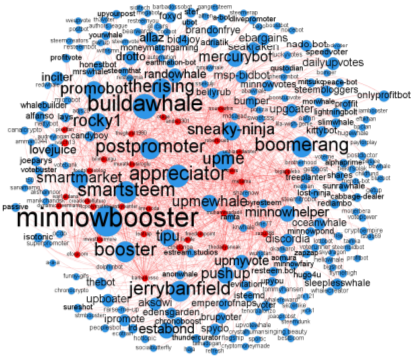
Graph of transfer operations sent from selected post authors (red) to the curators suspected to be bots (blue). The graph was plotted using Gephi.
Inflation and Emission:
The platform’s inflation rate decreases annually, starting from 9.5% in 2016. Inflation-generated tokens fund the reward pool, witness payments, and platform development. While intended to sustain early user growth, this high initial inflation diluted token value over time.
Despite these mechanisms, the design enabled several exploitative behaviors, such as self-voting, vote-selling services, and collusion among high-SP holders. These flaws highlight the importance of carefully balancing token distribution, inflation control, and user incentives.
Lessons and Implications
The Steemit case underscores two core challenges for blockchain-based social media platforms: achieving true decentralization and safeguarding incentive systems from abuse. DPoS, while efficient, appears insufficient in preventing power consolidation. Similarly, without robust anti-manipulation measures, reward systems become vulnerable to exploitation, defeating their purpose.
For future platforms, addressing these issues is non-negotiable. Transparent governance structures, enhanced verification protocols, and stricter mechanisms to detect and deter bots could improve decentralization and fairness.
Mistakes in Steemit’s Token Incentives
Steemit’s tokenomics, while innovative, contained several design flaws that contributed to the platform’s challenges. The most significant issues stemmed from the structure of its incentive system and token distribution:
Overemphasis on Stake-Based Voting:
Steemit’s reward allocation heavily favored users with large token holdings. Those with more Steem Power had disproportionate influence over content curation, leading to a system where wealthier users could dominate rewards. This design discouraged new users and created an environment where early adopters or large investors benefited at the expense of broader community participation.Insufficient Anti-Sybil Measures:
While designed to prevent spam and manipulation, the tokenomics failed to implement robust mechanisms against Sybil attacks. Users could create multiple accounts to upvote their content or form vote-buying rings, distorting the reward distribution.Liquidity Incentives Leading to Dumping:
Steemit allowed immediate liquidity for rewarded tokens. This lack of proper vesting or lock-up mechanisms enabled users to quickly sell earned tokens, contributing to market volatility and price declines. Without aligned long-term incentives, many participants focused on short-term gains rather than platform growth.Misaligned Curation Rewards:
The curation reward structure encouraged quick, automated upvotes rather than thoughtful engagement with content. Bots and scripts could outcompete genuine curators, undermining content quality and the intended purpose of the curation system.Limited Ecosystem Utility:
Steem tokens had narrow utility confined to the Steemit platform. Without broader use cases, token demand remained limited, further challenging long-term value retention.
These missteps highlight the importance of designing incentive systems that balance early adoption rewards with sustainable growth and fair participation.
Conclusion
Steemit’s experiment with blockchain-driven social media presents valuable lessons. While the concept of decentralized content platforms remains compelling, practical hurdles persist. Without addressing centralization tendencies, flawed token incentives, and system abuse, such platforms risk compromising their foundational ideals.
Build Sustainable Tokenomics with Coinstruct
Designing tokenomics that align incentives, promote sustainable growth, and prevent system exploitation is no simple task. Steemit’s case highlights how small missteps in incentive structures can lead to significant long-term challenges. To avoid similar pitfalls, partnering with experienced professionals is essential.
Coinstruct — is a specialized agency for full-cycle Web3 tokenomics development where we have a team of diverse specialists from PhD mathematicians, computer scientists to degens from leading DAOs working together to create advanced token models, reward systems, economy audits and scoring. Our focus is to create Web3-native sustainable economic solutions to help crypto projects achieve desired goals through tokens: from fundraising to increasing user base, retention and loyalty. We have successfully developed more than 40 blockchain-based economies for various Web3 ventures (DEXes, CEXes, GameFi, FinTech, DEXes, OTC platforms, P2E, NFTs and many more).
Contact Coinstruct today — to create tokenomics that work.